
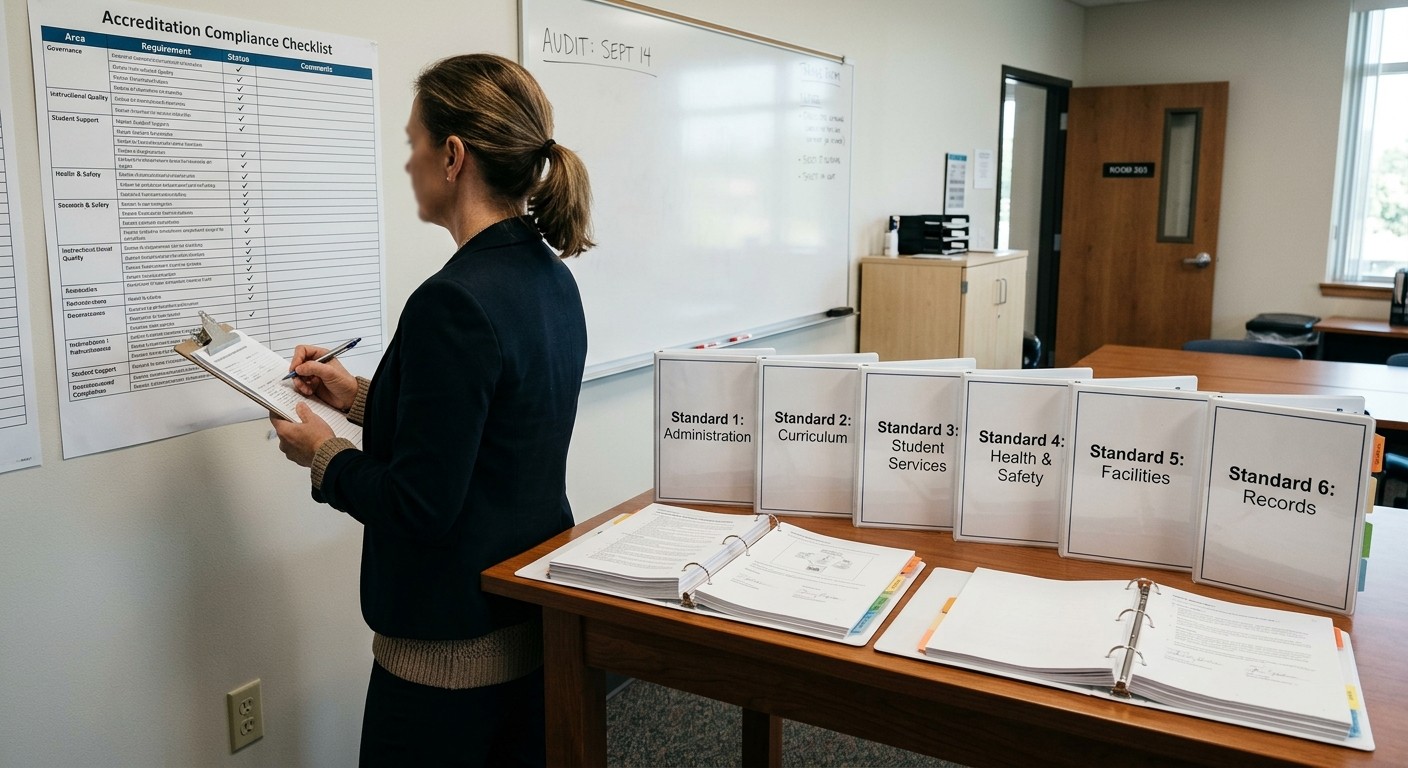
An Audit Is Not a Brand Inspection
Many training providers approach accreditation as though it were a reputational review — a chance to present polished materials and a credible story. Assessors operate on an entirely different logic. Their job is to determine whether a school can consistently design, deliver, assess, and improve qualifications against published requirements, and then prove it through evidence that can be independently verified.
The mechanism for that proof is triangulation. Assessors cross-reference documents against interviews, observed teaching against learner work, assessor decisions against certification records. A compelling prospectus and a well-structured curriculum map are starting points, not conclusions.
The Six Areas Under Scrutiny
1. Qualification Design
Auditors examine whether learning outcomes are clearly defined, whether entry requirements and learning hours are proportionate, and whether the qualification maps credibly to the relevant national framework or European Qualifications Framework level. Importantly, EQF alignment supports international comparison — it does not automatically confer national regulation or legal recognition. That distinction matters considerably for fitness schools marketing qualifications across borders.
2. Assessment Validity
The core question here is whether assessment methods genuinely test the stated outcomes. In fitness-specific audits, this typically means a combination of written theory assessment and observed practical performance. Assessors will review assessment instructions, marking criteria, feedback records, appeals procedures, reasonable-adjustment policies, and authenticity controls. A school that relies on theory papers alone to certify practical competence will struggle under this scrutiny.
3. Assessor Consistency
External-verification systems exist precisely to answer one question: do different assessors applying the same criteria reach comparable conclusions? Auditors sample learner evidence and assessment decisions across centres to confirm that criteria are applied consistently and that certification claims are supported by auditable records. In fitness education, this often means an assessor will observe a training session or review video footage, then compare their own judgement against the assessor's written feedback and completed paperwork. This tests assessor reliability as directly as it tests learner performance.
4. Staff Competence
Current CVs, subject-matter expertise, teaching and assessor qualifications, continuing professional development logs, workload controls, standardisation activity records, and conflict-of-interest procedures are all in scope. Staff competence is not assumed from job titles — it must be documented and current.
5. Learner Protection
This category covers accurate advertising, complaints and appeals processes, safeguarding, health and safety, data protection, malpractice procedures, attendance records, and secure certificate issuance. Gaps here carry serious consequences, because regulators in several EU member states treat learner-protection failures as grounds for immediate suspension of approval.
6. Quality Improvement
Management review cycles, learner and employer feedback mechanisms, incident logs, corrective actions with deadlines, and evidence that recurring problems were actually resolved — not merely recorded — form the final layer. An audit trail full of identified problems with no closed corrective actions signals a system that monitors itself without improving itself.
Timelines, Costs, and the Sampling Principle
There is no EU-wide fee schedule or universal weighting system for accreditation. Awarding bodies publish their own criteria, and national regulators may impose additional conditions on top. A useful principle borrowed from regulated qualification quality assurance is sampling: assessors do not check every learner file, but the sample must be large and structured enough to test authenticity, validity, reliability, and consistency across the full scope of certification.
For certification bodies operating under ISO/IEC 17065, industry estimates place an initial accreditation cycle at roughly nine to eighteen months from application to certificate, with first-year external accreditation fees around £13,000 for a small-scope example — before travel and internal preparation costs. These figures apply to certification-body accreditation specifically; a fitness training school seeking programme approval will face a different fee structure depending on the awarding body and scope.
ISO 21001 addresses educational organisations' management systems; ISO/IEC 17024 concerns personnel-certification bodies. Holding either standard does not, on its own, confirm that a personal-training qualification is professionally or legally recognised in any given country.
Four Misconceptions That Create Real Risk
'EQF level equals a licence to practise.' It does not. Requirements for fitness-related professions vary significantly across EU member states; some require state or federation licensing that a qualification framework level cannot substitute.
'A polished manual is sufficient.' Auditors test implementation through learner evidence, observed assessment, records, and direct interviews — not through documentation alone.
'Accreditation is a one-time achievement.' Surveillance visits, reassessments, complaints investigations, and corrective-action evidence are structural features of continuing approval, not optional extras.
'More contact hours guarantee quality.' Auditors focus on demonstrable outcomes, assessment reliability, and evidence of safe practice — hour counts are inputs, not proof of competence.
What Each Stakeholder Should Do Differently
Training schools should maintain a live audit trail, map every learning outcome to verifiable evidence, run regular assessor-standardisation exercises, and budget explicitly for recurring surveillance — not just initial approval. Fitness professionals evaluating qualifications should verify the awarding body's status, the qualification's EQF and national-framework position, the practical assessment requirements, and whether target employers or regulators actually recognise it. Hiring facilities should inspect the scope of certification and the competence evidence behind it, rather than treating an accreditation logo as a substitute for due diligence.
Read more blogs


Recognised by the European Commission Initiative
ESWA is the European body for the verification, validation, and certification of professional standards in the fitness and wellness sector. House of Sport, Avenue des Arts 43, B-1040 Brussels, Belgium. VAT: BE0123456789.