
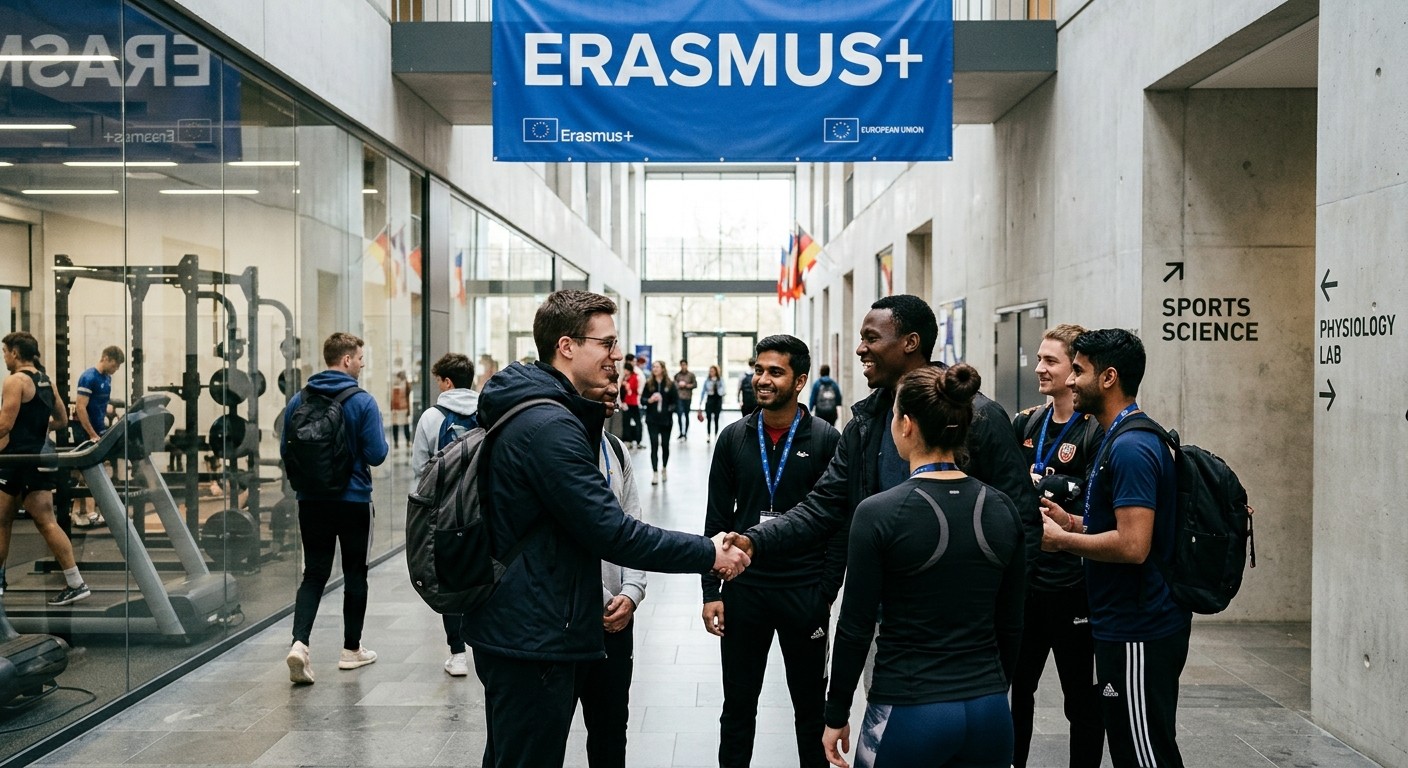
What the European Commission Has Confirmed
On 19 October 2026, the European Commission published its official list of projects selected under the international cooperation strand of vocational education and training (VET) within the 2026 Erasmus+ call for proposals. The announcement confirms that the selection process for this funding cycle is complete and that cross-border VET cooperation projects are now formally approved and moving into implementation.
For training schools operating in the fitness and sport sector, this is the most concrete signal yet that the 2026 Erasmus+ funding architecture is open and active — and that the window for positioning organisations ahead of future calls requires attention now.
How the Funding Mechanism Works
The 2026 Erasmus+ Programme Guide defines small-scale partnerships as the entry-level instrument for organisations in VET and sport. These projects run for between six and 24 months and carry lump-sum grants of either €30,000 or €60,000 — fixed amounts designed to reduce administrative burden for smaller providers and first-time applicants.
Applications for VET mobility and cooperation partnerships are routed through national agencies in each participating country, meaning the process is decentralised. A training school in Portugal, for example, would apply through its national Erasmus+ agency rather than directly to Brussels. Sport-specific cooperation partnerships follow a parallel but distinct track within the programme.
International cooperation projects under the VET strand are structured around multilateral partnerships — typically involving organisations from at least two or three countries. The practical outputs can include jointly developed curricula, mutual recognition frameworks, staff mobility schemes, and shared assessment tools.
What This Means for the Fitness Sector
The published selection announcement does not identify a named fitness-instructor consortium among the confirmed 2026 projects. The sector-specific link in the public summary remains unconfirmed. However, the mechanism is clearly available to fitness VET providers: Erasmus+ explicitly recognises organisations working in sport and physical activity as eligible applicants under both the cooperation partnership and the small-scale partnership instruments.
Industry data indicates that the European fitness sector employs hundreds of thousands of professionals across 27 member states, with significant variation in how national qualifications are structured, assessed and recognised across borders. That qualification fragmentation is precisely the problem that Erasmus+ international cooperation projects are designed to address — making this funding strand structurally relevant even when no fitness-specific project has been publicly named in the current cycle.
A separate Commission overview of Erasmus+ sport actions projects, updated on 7 October 2026, highlights live initiatives using sport and physical activity to address participation, inclusion, employability and skills development. One featured project converts urban spaces into temporary fitness zones to promote physical activity at community level; another targets women's employability and vocational training in sport. Neither constitutes a formal fitness-instructor qualification framework, but both demonstrate that sport-adjacent projects with a physical activity and skills dimension are being funded and reported at Commission level.
What Training Schools and Providers Should Do
The confirmation of the 2026 selection cycle gives providers a clear reference point. Organisations that missed this call should treat the published project list — once full details become available through national agencies — as a benchmarking tool: understanding what consortia were approved, which countries are active partners, and what project designs succeeded.
Identify your national agency contact now. VET cooperation applications are managed at national level, and relationship-building with agency staff ahead of a call significantly improves application quality.
Map potential consortium partners in at least two other participating countries. Erasmus+ international cooperation projects require multilateral involvement; solo applications are not eligible.
Align project objectives to qualification recognition where possible. Projects that produce transferable outputs — shared competency frameworks, mutually recognised assessments, joint curricula — have a clearer policy rationale and tend to score more strongly against Erasmus+ selection criteria.
Consider the small-scale partnership route first if your organisation has no prior Erasmus+ experience. The €30,000 lump-sum format with a six-month minimum duration is a realistic entry point for schools that want to build cross-border capacity without committing to a multi-year project immediately.
The Broader Policy Signal
The 2026 Erasmus+ cycle, now confirmed as active, reinforces the European Commission's continued investment in VET as a cross-border policy instrument. For fitness education providers seeking accreditation or operating across multiple national markets, the programme represents one of the few publicly funded routes to build qualification portability into their curricula by design rather than by retrospective negotiation. The next call cycle is the moment to act on that.
Read more blogs


Recognised by the European Commission Initiative
ESWA is the European body for the verification, validation, and certification of professional standards in the fitness and wellness sector. House of Sport, Avenue des Arts 43, B-1040 Brussels, Belgium. VAT: BE0123456789.